Part-Time Work Rules for Tier 4 Visa Holders: What You Can and Can’t Do in 2026
By Sophia Tan
May 15, 2026
If you hold what's still commonly called a Tier 4 visa (officially the Student visa since 2020), you can work up to 20 hours per week during term time if you're enrolled in a degree-level course at a Higher Education Provider with a track record of compliance — and full-time during official vacations. What trips students up isn't the headline number; it's the small print around self-employment, what counts as a “week,” and which jobs are outright banned. Get it wrong once, and you risk visa curtailment, deportation, and a 10-year ban on returning to the UK.
This is the 2026 reality check, written for students who'd rather understand the rules than learn them the hard way.
First, a name correction: Tier 4 is now the Student visa
Most international students still type “Tier 4” into Google, and that's fine — but the Home Office officially scrapped that label in October 2020. Your BRP or eVisa says Student or Child Student. The rules are largely the same, but immigration officers, employers running right-to-work checks, and HMRC all use the new terminology. If you're filling out a job application and the dropdown only shows “Student visa,” that's you.
Why does this matter practically? Because some employers — especially small businesses unfamiliar with immigration law — get confused and reject valid candidates. Knowing the correct name lets you push back politely and direct them to the Home Office's online right-to-work checking service.
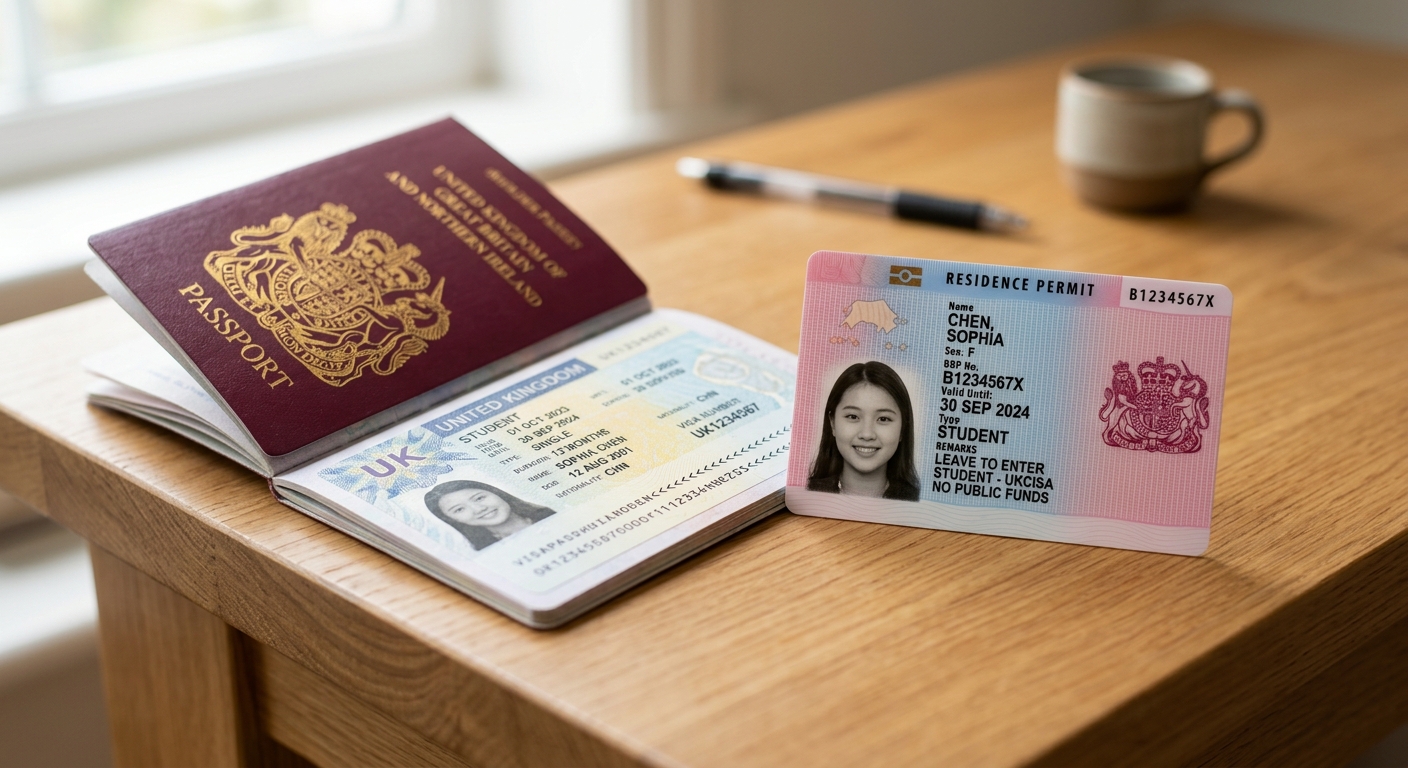
UK Student visa biometric residence permit and passport on a desk
The 20-hour rule: what actually counts as a week
This is where students get burned. A “week” under Home Office definitions runs from Monday to Sunday — not a rolling seven days, not your employer's payroll week. If you work 18 hours Monday to Friday and pick up a 6-hour shift on Saturday, you've breached your visa by 4 hours. There's no averaging across weeks.
And it's a maximum, not a target. The 20 hours includes all paid and unpaid work, voluntary work that has the characteristics of employment (i.e. taking the place of a paid role), and any second job. If you have two part-time jobs at 12 and 10 hours, you're over the limit even though neither employer alone would notice.
What happens if you go over?
Breaching work-hour conditions is one of the fastest ways to lose your visa. The Home Office cross-references HMRC payroll data through Real Time Information (RTI). Caseworkers have refused subsequent visa applications years later citing a single week of over-work. For example, a postgraduate student at a London university lost her Graduate visa application in 2024 after HMRC records showed three weeks where she'd worked 22, 24, and 21 hours during term time.
Weekly planner showing tracked part-time work hours for a student visa holder
What's term time vs vacation — and who decides
Your sponsor university decides official term and vacation dates, not you. They report these dates to the Home Office through your CAS and any updates. The published academic calendar is what counts — not when your last seminar finishes or when your housemates fly home.
Three practical points most students miss:
Dissertation periods count as term time for most master's students, even when no classes are scheduled. Check your specific course handbook.
Resit periods are usually term time if you're sitting exams.
The gap between finishing your course and your visa expiring (typically 2–4 months for postgrads) is treated as vacation — you can work full-time during this window, which is gold for graduates job-hunting.
If you're unsure, email your international student office and get the dates in writing. Saving that email could save your visa.
Jobs you absolutely cannot do
The Home Office has a hard list of prohibited activities. Even one day in one of these roles is a visa breach.
Self-employment of any kind — no freelancing on Upwork, no Etsy shop, no “side hustle” selling on Vinted at scale, no UberEats or Deliveroo (these are classed as self-employed in the UK).
Working as a professional sportsperson, including paid coaching.
Working as an entertainer — paid DJ gigs, modelling, paid acting.
Permanent full-time positions, even if you only do them part-time hours.
Doctor or dentist in training, unless on a recognised foundation programme.
The self-employment rule is the silent killer. A computer science student earning £400 a month from Fiverr coding gigs is, technically, breaching visa conditions — even if they're under 20 hours and declaring tax. The fix is to work through an umbrella company or as a registered employee, not as a sole trader.
Food delivery gear representing self-employed work prohibited under Student visa rules
Internships, placements, and unpaid work
Here's where it gets nuanced. If your course includes a placement as an integral assessed part of the degree, it doesn't count toward your 20-hour limit — but it must be approved by your sponsor and can't exceed 50% of your total course length for degree students (33% for below-degree).
Standalone internships you find yourself? They count as work. A 35-hour-a-week summer internship at a law firm during your June–September vacation is fine. The same internship squeezed in alongside lectures in October is not.
Unpaid volunteering is allowed and doesn't count toward your 20 hours — but only if it's genuine volunteering for a charity or non-profit, with no contractual obligation, no payment in kind (free meals beyond reasonable expenses count as payment), and the role isn't one that would normally be paid. Helping at a registered charity shop on Saturdays: fine. “Volunteering” at a friend's café in exchange for tips: not fine.
Proving your right to work: the 2026 process
Since the full eVisa rollout completed in early 2025, most students no longer have a physical BRP. Employers verify your right to work through the Home Office's online checking service using a share code you generate from your UKVI account.
The share code is free, valid for 90 days, and tells the employer your work conditions including the exact hours allowed. Generate it before your interview — small employers often won't know to ask, and you'll seem more prepared. Keep a screenshot of your conditions for your own records too.
If an employer insists on seeing a physical BRP and you have a digital-only status, point them to gov.uk's employer guidance. This is now standard, but the message hasn't reached every corner shop and restaurant.
Tax, National Insurance, and the bits no one warns you about
You pay UK income tax and National Insurance like any other worker — your student status doesn't exempt you. The 2026 personal allowance is £12,570, meaning most students working 20 hours at minimum wage (£11.44/hour for over-21s as of April 2024, with the 2026 uprating bringing it close to £12.40) won't pay income tax on term-time earnings alone.
But two things catch students out:
Emergency tax codes. Without a P45 from a previous UK job, your first employer often puts you on a BR or 0T code, taxing you at 20% from pound one. You'll get it back, but only after filing a refund claim. Submit a P46 / starter checklist correctly to avoid this.
Student loan repayments. If you took out a UK student loan for your course (rare for internationals, but it happens), repayments kick in automatically above the threshold.
For a deeper look at how working hours affect your overall student budget, our breakdown of student value across major UK cities shows how much 20 hours of part-time work actually offsets your rent.
UK payslip and budget calculator showing student part-time earnings
Finding work that respects your visa
Some employers are visa-friendly by default; others will waste your time. Universities themselves are the best starting point — campus jobs in libraries, student unions, open-day teams, and research assistant roles know the rules cold and structure shifts around the 20-hour cap.
Retail chains (Tesco, M&S, Boots, Pret) have standardised right-to-work processes that handle student visas smoothly. Hospitality is hit-or-miss: large hotel groups are generally fine, independent pubs and restaurants sometimes pressure students to work cash-in-hand or over the cap. Walk away from any employer who asks you to under-report hours or accept cash to bypass payroll. They're not protecting you — they're protecting themselves, and HMRC will catch the discrepancy.
For instance, an engineering master's student at a Russell Group university might combine 8 hours/week as a library assistant (£12.50/hour, predictable shifts) with 10 hours/week at a campus coffee shop. That's £230+ per week, fully visa-compliant, with shifts that bend around exam periods. If you need help mapping which universities have the strongest student-employment support, our school finder and study in the UK guide are good places to start.
What changes after you graduate
Your Student visa permits full-time work from the day after your course officially ends until the visa expires — typically 2–4 months. This is the “wrap-up” window most students don't realise they have.
If you want to keep working without restrictions, the Graduate visa (still 2 years for bachelor's and master's, 3 years for PhD as of 2026) lets you work in any job, at any level, including self-employment, with no sponsorship required. You must apply before your Student visa expires and while still in the UK. There's no salary threshold, no job offer needed — just proof of successful course completion from your sponsor.
Beyond that, the Skilled Worker route needs a sponsoring employer and meets the going salary threshold (currently £38,700 for most roles, with some new-entrant discounts). Plan your job search around these dates from day one of your final year, not after graduation.
Quick reference: don't let one mistake cost you the UK
The rules sound strict because they are. But thousands of international students work part-time every term without issue by following three habits:
Track hours by the Monday–Sunday week, not by payslip period.
Stay employed, never self-employed, while on a Student visa.
Keep written confirmation of your university's term dates.
If you're still in the application stage and want clarity on how working rights fit with your chosen course, our application guide and the support team can walk you through it before you arrive. And if you're newly landed and trying to decode shift-manager English, our British slang survival kit will save you a few awkward shifts. Reach out via contact us if you want a personal review of your situation — better to ask now than appeal a refusal later.
Sophia Tan
Sophia Tan is an international education consultant at Eduviai. Having studied and worked across three UK cities herself, she writes practical guides that help students weigh tuition, lifestyle, and career outcomes side by side. When she's not advising applicants, she's usually testing out new student cafés in Manchester's Northern Quarter.
Tell us a bit about your child and what you're looking for. We'll help you explore schools that match your requirements, whether you already have a shortlist or you're just starting.

 About UsHonest, expert guidance for international families. Never commission-driven.Discover
 How We WorkFrom your first visit to the first day at school, we guide every step.Discover
 Application GuideFrom documents to offer letter, the UK application process made clear.Discover
 Our PriceOne straightforward service fee. No school commissions, ever.Discover
 Testimonials1,200+ students from 40+ countries. Read their stories.Discover
 Behind the PlatformMeet the team behind EduviaiDiscover
 Find a SchoolTell us about your child and we’ll match you with verified UK schools that fit.Discover
 To study in the UKFrom age 4 to postgraduate, every stage, qualification, and admissions route explained.Discover
 Life in the UKAccommodation, culture, transport, and budgeting for international students, all in one place.Discover