Opening a UK Bank Account as an International Student in 2026: Monzo, Starling, HSBC or Revolut?
By Sophia Tan
May 15, 2026
For most international students arriving in the UK in 2026, Monzo or Starling is the quickest route to a working bank account — both can be opened from your phone within 1–3 days of landing, using just your passport, BRP or eVisa share code, and a UK address. HSBC is worth the extra hassle only if you specifically need a high-street branch or plan to stay long-term. Revolut is brilliant as a backup for currency conversion, but it should not be your primary account because it’s technically an e-money provider, not a UK bank.
What “opening a UK bank account” actually requires in 2026
The rules tightened in 2024 and most banks now follow the same checklist. You need three things: a valid passport, proof of UK immigration status (your BRP card or, increasingly in 2026, an eVisa share code from the Home Office), and a UK address you can prove.
The address part is where students get stuck. Banks accept a university acceptance letter (CAS or enrolment confirmation) showing your halls address, a tenancy agreement, or in some cases just a self-declared address inside the app. Monzo and Starling are flexible here — HSBC and Barclays still want a physical letter from your university.
One thing that’s changed: most banks now verify your visa digitally against the Home Office system, so you no longer need to physically hand over your BRP. A share code from view-and-prove-your-immigration-status.service.gov.uk is enough.
Passport (biometric page)
BRP or eVisa share code
UK address proof OR university enrolment letter
A UK phone number (helpful, not always essential)
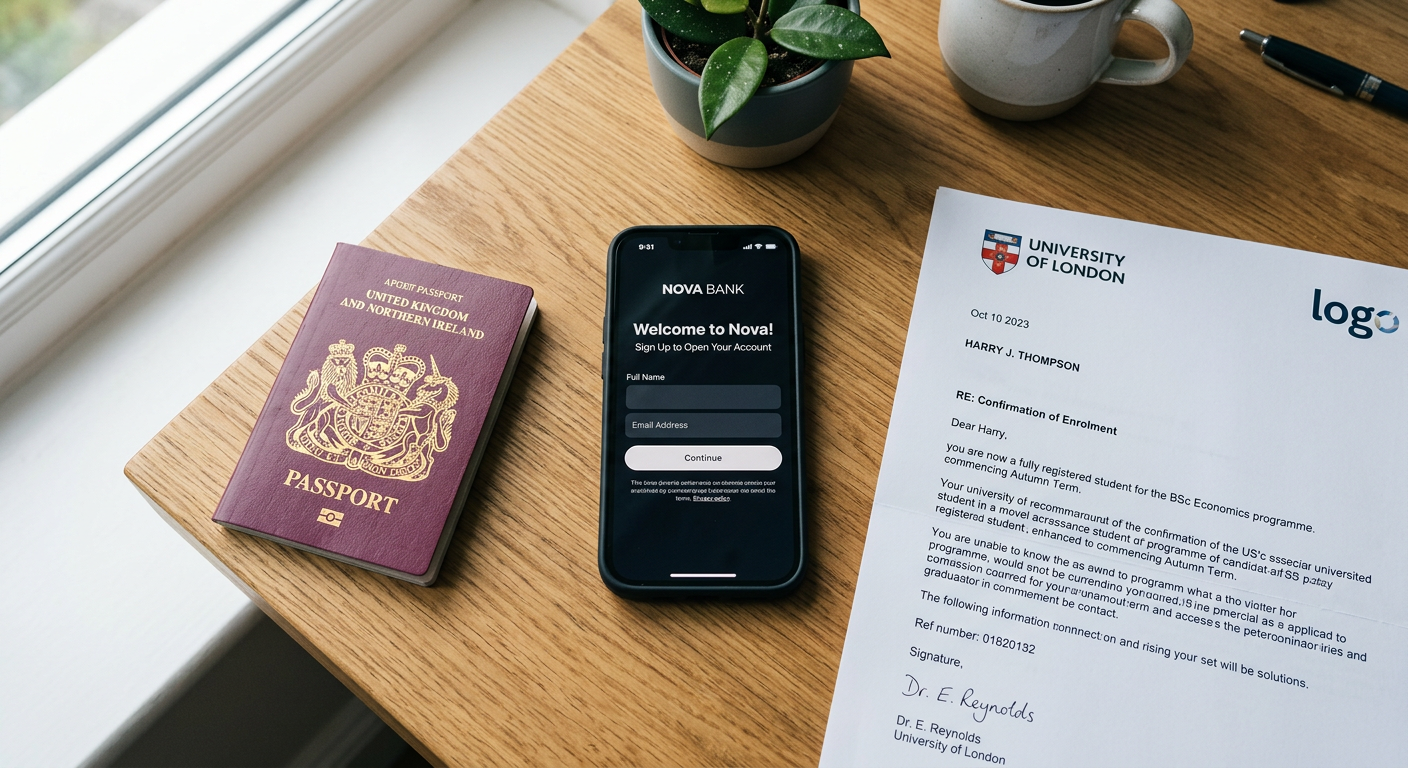
Passport, smartphone showing banking app and university letter on wooden desk
Monzo: the default choice for most students
Monzo has quietly become the default student bank, and there’s a reason for that — it just works. You download the app, scan your passport, do a 10-second video selfie, and the card arrives at your UK address in 2–3 working days. No branch visit, no waiting six weeks.
What makes it strong for students
Instant notifications on every transaction (useful when you’re still learning how much £4.20 actually feels like)
Pots for splitting rent, bills and food budgets
Bill splitting with flatmates via a shared link
Free ATM withdrawals up to £250 per month abroad
Proof-of-address PDF you can download instantly — landlords and the council accept it
The catches
International transfers used to be Monzo’s weak spot, but in 2026 they route through Wise inside the app with a 0.35–1% fee depending on currency. That’s competitive but not the cheapest. The Monzo Plus tier (£5/month) adds credit-building features and interest, which is rarely worth it for a one-year master’s student.
For example, a Nigerian master’s student arriving in Manchester in September could open Monzo on the train from Heathrow, receive the card at their halls by Friday, and use the in-app address letter to register with a GP the following week — no branch visit needed.
Coral Monzo-style debit card on a notebook beside a budgeting app on a laptop
Starling: the better choice if you actually budget
Starling is Monzo’s quieter, more grown-up sibling. The opening process is almost identical — app, selfie, passport scan, card in 1–2 days — but the underlying product is built for people who care about money management rather than just spending.
Where Starling pulls ahead:
Spaces (their version of pots) earn interest at the standard savings rate — currently around 3.25% AER in early 2026
No fees on debit card spending abroad, anywhere in the world, including ATM withdrawals up to £300/month
Built-in spending analytics that categorise transactions automatically (no manual tagging)
Excellent customer service — 24/7 UK-based humans, not chatbots
The drawback? Starling has no “social” features. No bill-splitting links, no shared tabs with flatmates, no Apple Cash-style nudges. If your flat is the kind that runs a weekly groceries pool, Monzo wins. If you live alone or just want to track every penny, Starling is the better tool.
Teal blue debit card with notebook of budget categories on minimalist desk
HSBC International Student Account: when it’s actually worth the wait
HSBC is the only major high-street bank that still markets a dedicated international student account in 2026. You can pre-apply from your home country up to three months before arriving, which sounds great — until you realise you still need to attend a branch appointment in the UK to activate it.
When HSBC makes sense
You’re studying for 3+ years (undergraduate or PhD) and want a banking relationship that survives graduation
You plan to apply for UK credit cards or a mortgage later — branch-bank history matters
Your parents in your home country already use HSBC Premier and can link the accounts for instant family transfers
You want a real cheque book or banker’s draft (some universities still need these for specific deposits)
What to expect
Expect 2–4 weeks from application to activated card. You’ll need to book a branch appointment, bring originals of every document, and answer questions about your funding source. HSBC’s app is functional but feels like 2018 compared to Monzo or Starling.
For a one-year postgraduate student, the effort rarely pays off. For a four-year undergraduate from Hong Kong or Singapore whose family already banks with HSBC internationally — it’s genuinely useful.
Revolut: powerful, but don’t make it your main account
Here’s the thing about Revolut that students often miss: it’s not a UK bank. It operates as an e-money institution under FCA authorisation, which means your funds are safeguarded but not protected by the £85,000 FSCS deposit guarantee that Monzo, Starling and HSBC offer.
For day-to-day life, that distinction rarely matters. For receiving a £15,000 tuition refund, it absolutely does.
Where Revolut wins
Hold and convert 30+ currencies at near-interbank rates (free up to £1,000/month on the standard plan)
Instant transfers to other Revolut users anywhere in the world
Disposable virtual cards — useful when you’re paying a sketchy-looking online subscription
Crypto and stock trading inside the same app, if that’s your thing
The smart play
Use Revolut as your “international wallet” — keep £100–£500 in it for travel, currency conversion, and online shopping. Receive your student loan, scholarship payments and any UK part-time wages into Monzo or Starling. That way you get the best of both worlds without exposing your tuition fund to e-money risk. Speaking of part-time wages, the rules for working on a Tier 4 visa are worth reading before you take any job.
The 30-minute strategy: which to open first, and when
Don’t open all four. You’ll confuse your direct debits and tank your future credit file. Here’s the sequence that works for most students:
Before you fly
Open Revolut from your home country. Takes ten minutes. Top it up with £300–£500 so you have spending money the moment you land — you can pay for the train, your first SIM, and groceries before any UK bank account is live.
Within your first week
Apply for Monzo or Starling from the app the day after you arrive at your accommodation. Use your halls or rental address. Card arrives in 1–3 days. As soon as it’s active, use the in-app address letter to register with a GP, the council, and your university finance office.
Month 2 onwards (optional)
If you need a high-street relationship for the long term, book your HSBC branch appointment. By this point you’ll have an enrolment letter, a council tax exemption letter and a payslip if you’re working — branch appointments are smoother with paperwork in hand.
If you’re still deciding between cities and how this all fits into your wider student budget, our breakdown of Manchester vs Birmingham vs Glasgow covers cost of living in detail.
Laptop showing international money transfer confirmation with exchange rate
Receiving tuition and large transfers from home: the rule no one tells you
This is where students lose the most money. A wire transfer of £18,000 in tuition fees through a traditional bank can cost £200–£600 in hidden FX margin — and your home bank usually won’t tell you the rate until after they’ve done it.
Three safer options
Wise (formerly TransferWise): mid-market rate plus 0.4–0.6% fee. For £18,000, that’s about £80–£110 total. Pay directly to your university’s bank account or to your Monzo/Starling.
Flywire or Convera: most UK universities now partner with one of these for tuition specifically. The rate is decent and the payment is automatically tagged to your student ID — no “where did this £18,000 come from?” questions from the bank.
Family HSBC Premier or DBS Treasures link: instant and free between accounts within the same bank group, but only if your family already has the relationship.
For example, a student from India sending £20,000 in two instalments saved around £450 using Wise instead of her parents’ standard bank transfer — enough to cover six weeks of groceries.
Avoid sending the full year’s living costs in one transfer. Send tuition separately, then keep 2–3 months of living costs in your UK account and top up as needed.
Building a UK credit file from day one
Most international students don’t think about credit until they try to rent a flat in year two and get rejected. UK landlords, mobile contract providers, and utility companies all check your Experian or Equifax file. A new arrival has none — which counts against you.
Three small habits build a file fast:
Register on the electoral roll if you’re eligible (Commonwealth and Irish citizens can; EU citizens generally cannot post-Brexit). This alone boosts your file visibility.
Set up at least one direct debit on your Monzo or Starling — a phone contract, gym membership, or Spotify Family works. Never miss it.
Apply for a credit-builder card after 3–6 months — Aqua, Capital One Classic, or the Monzo Flex feature. Spend £20/month, pay it off in full, repeat.
By the end of year one you’ll have a useable credit score. By graduation, you’ll be able to rent without a UK guarantor — which saves the £600–£1,200 fee that guarantor services like Housing Hand charge.
Picking the right one for your situation
If you’re still on the fence, here’s the shortest possible decision tree:
One-year master’s, want zero hassle → Monzo + Revolut
Budget-conscious, like data and analytics → Starling + Revolut
3+ year undergrad, family banks with HSBC → HSBC + Monzo
Travelling often within Europe → Starling (free FX) + Revolut
PhD or research student receiving stipend → Starling (interest on Spaces) + Wise for transfers
None of these choices is permanent. You can switch your main account in under seven days using the UK Current Account Switch Service, which moves all your direct debits automatically. So don’t overthink it — open Monzo or Starling this week and adjust later if needed.
If you’d like a hand mapping out your full pre-arrival checklist — visa, accommodation, banking, GP registration — the team at Eduviai walks students through it every week. Take a look at our Expert Guide to Study in the UK or get in touch if you want one-on-one help before your flight.
Sophia Tan
Sophia Tan is an international education consultant at Eduviai. Having studied and worked across three UK cities herself, she writes practical guides that help students weigh tuition, lifestyle, and career outcomes side by side. When she's not advising applicants, she's usually testing out new student cafés in Manchester's Northern Quarter.
Tell us a bit about your child and what you're looking for. We'll help you explore schools that match your requirements, whether you already have a shortlist or you're just starting.

 About UsHonest, expert guidance for international families. Never commission-driven.Discover
 How We WorkFrom your first visit to the first day at school, we guide every step.Discover
 Application GuideFrom documents to offer letter, the UK application process made clear.Discover
 Our PriceOne straightforward service fee. No school commissions, ever.Discover
 Testimonials1,200+ students from 40+ countries. Read their stories.Discover
 Behind the PlatformMeet the team behind EduviaiDiscover
 Find a SchoolTell us about your child and we’ll match you with verified UK schools that fit.Discover
 To study in the UKFrom age 4 to postgraduate, every stage, qualification, and admissions route explained.Discover
 Life in the UKAccommodation, culture, transport, and budgeting for international students, all in one place.Discover